Most AI training programs fail within weeks. Here's a structured framework for building real AI capability inside Southeast Asian marketing teams that sticks.
Most marketing teams in Southeast Asia now have some version of AI in their stack. Almost none of them are using it well.
According to Social Media Examiner, the pattern is consistent: companies invest in AI training, employees show up, nod along — and within weeks quietly revert to their old workflows. The tools remain open in browser tabs. The habits don’t change. And the productivity gains that justified the investment never quite materialise.
This isn’t a technology problem. It’s a change management problem dressed in a ChatGPT interface.
Why Standard AI Training Fails Marketing Teams
Most AI training programs are built around features, not workflows. Teams learn what the tool can do in a vacuum — generate copy, summarise briefs, analyse data — but never rebuild their actual day-to-day processes around those capabilities. The result is surface-level fluency with no operational depth.
Social Media Examiner’s framework identifies a critical gap: the difference between employees who use AI occasionally and those who are genuinely augmented by it is the presence of structured, repeated practice tied to real work outputs. A content team in Manila that practises prompt engineering on live campaign briefs will outpace a Singapore team that completed a certification course but never changed how they open their Monday morning.
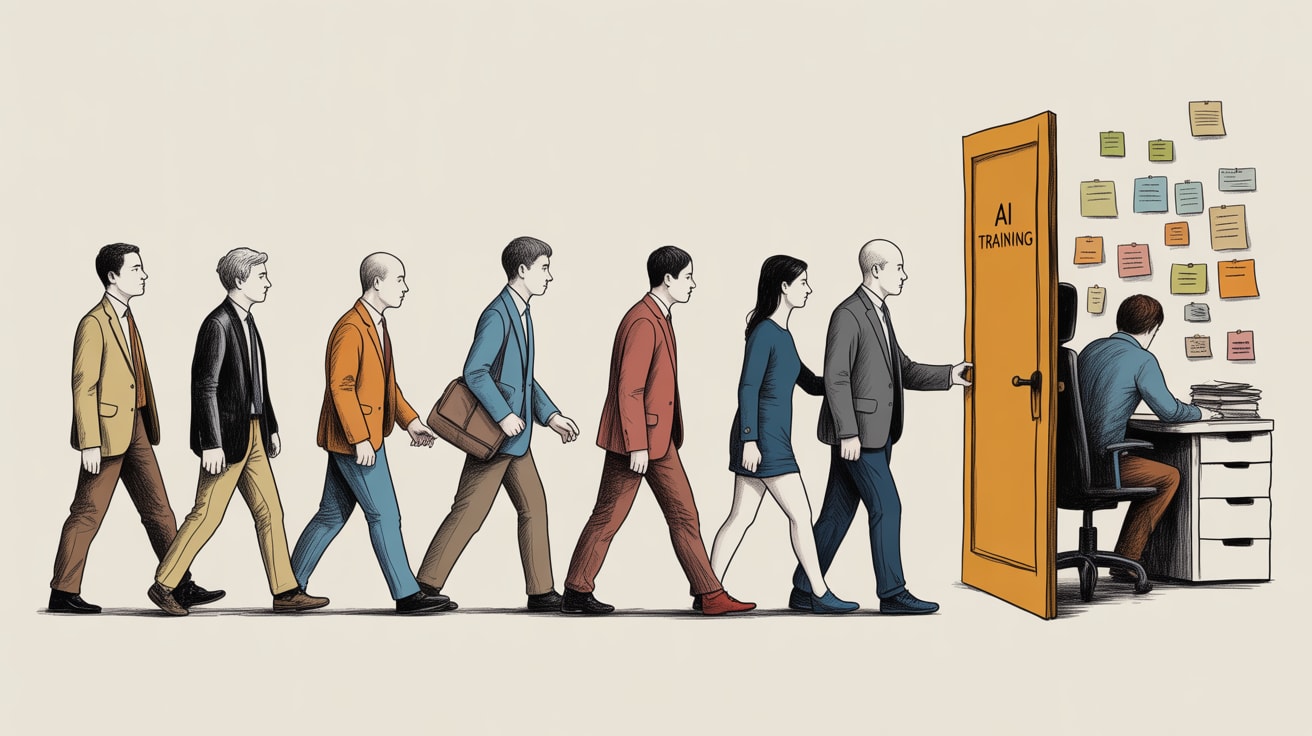
The failure mode to watch for: training that ends at the workshop. If AI capability isn’t embedded into standing workflows — editorial calendars, briefing documents, post-campaign reviews — it evaporates.
Building an AI-Augmented Workflow, Not Just an AI-Aware Team
The distinction Social Media Examiner draws between basic and advanced AI users is worth sitting with. Basic users treat AI as a shortcut. Advanced users treat it as a thinking partner — they iterate on outputs, push back on AI-generated reasoning, and use the tool to pressure-test their own assumptions before presenting to stakeholders.
For marketing teams, the practical path from basic to advanced runs through three stages: task replacement (using AI to do things faster), task augmentation (using AI to do things better), and workflow redesign (restructuring how the team operates around AI’s strengths).
Most teams stall at stage one. Getting to stage three requires leadership to actively redesign processes — not just grant tool access. A regional e-commerce brand running campaigns across Shopee and Lazada, for example, might start by using AI to generate product copy variations (task replacement), progress to using AI to analyse which copy patterns perform better by platform (augmentation), and eventually restructure their creative briefing process so AI-generated performance hypotheses are baked in from day one (workflow redesign).
The Culture Prerequisite Nobody Budgets For
Here’s the part that gets skipped in most AI rollout plans: culture.
Martech Zone’s analysis of growth in B2B service businesses makes a point that transfers cleanly to marketing team AI adoption — sustained performance improvement requires an environment where people feel safe experimenting, failing, and iterating. Without psychological safety, AI tools become compliance theatre. Employees use them when observed, not when it matters.
This has a specific texture in Southeast Asian workplace contexts, where hierarchy is often more pronounced and visible failure carries higher social cost. A junior copywriter in a Bangkok agency is unlikely to share a half-baked AI experiment with a senior creative director unless the team has explicitly normalised that behaviour. Leadership modelling matters here — when a CMO shares an AI prompt that produced a terrible output and explains what they learned from it, it changes what’s permissible for everyone below them.
The budget implication is real: building this culture requires facilitated team sessions, not just software licences. Factor that in before the procurement conversation.
What to Measure — and When to Worry
AI upskilling programs often lack the outcome metrics that would tell you whether they’re working. Time-to-first-draft reductions and prompt quality scores are proxies; what actually matters is whether the team is producing better strategic outputs faster, with fewer revision cycles.
Two metrics worth tracking from week one: revision rate (how often AI-generated outputs require significant human rework before use) and workflow adoption rate (what percentage of relevant tasks are actually routed through AI processes). Both should improve over a 60-day period if training is landing. If revision rates plateau high, the problem is usually prompt quality — a skills gap. If adoption rates plateau low, the problem is usually workflow design or culture — a leadership gap.
For teams running multilingual campaigns across markets like Indonesia, Thailand, and Vietnam, there’s an additional layer: AI outputs in non-English languages require stronger human review protocols. Local language model quality varies significantly by tool, and the reputational cost of a mistranslated campaign line in Bahasa Indonesia is not theoretical.
Key Takeaways
- Embed AI practice into live workflows from day one — training without workflow redesign produces compliance, not capability
- Track revision rate and adoption rate as leading indicators of whether upskilling is genuinely landing
- In hierarchical workplace cultures, leadership modelling of AI experimentation (including failure) is a prerequisite for team-wide adoption
The teams that will pull ahead over the next 18 months aren’t necessarily the ones with the most sophisticated AI tools. They’re the ones that figured out how to make AI use a habit, not an event. The question worth sitting with: does your current training program end at the workshop, or does it actually change what happens on Monday morning?
At grzzly, we work with marketing teams across Southeast Asia on exactly this — building AI capability that survives contact with real campaign pressure, not just training-room conditions. If your team has the tools but not yet the habits, we’d be glad to think through that with you. Let’s talk
Sources

Written by
Vintage GrizzlySynthesising channel intelligence, audience psychology, and market context into coherent growth strategies. Old enough to remember the last paradigm shift; sharp enough to see the next one forming.