
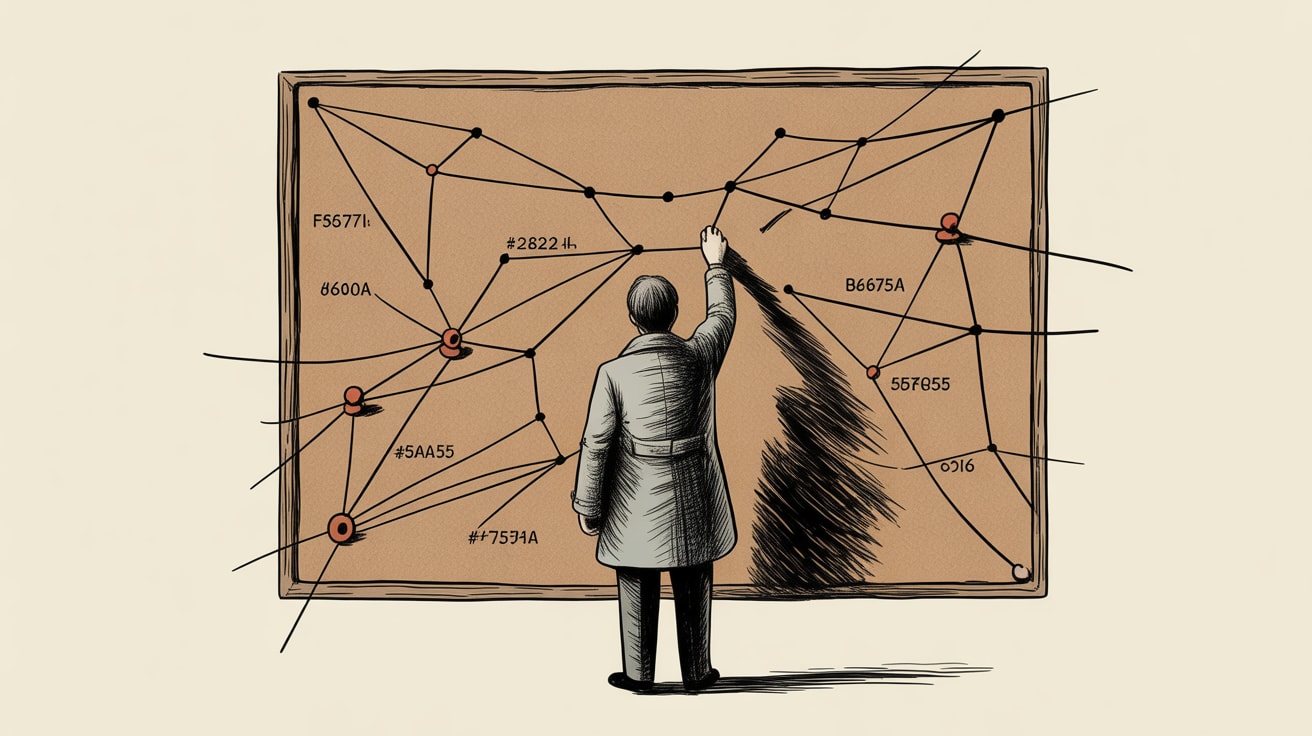
Stop treating customer engagement like a fixed truth. Bayesian inference shows how smarter probabilistic models beat batch-and-blast logic every time.
Most customer engagement platforms are running on the data equivalent of a closed verdict — a fixed customer profile built from historical behaviour, periodically refreshed in batch cycles, and used to fire messages as if the conclusions were already certain. The problem isn’t the data. It’s the epistemology.
Your Segmentation Model Is Making the Wrong Kind of Assumptions
A recent Towards Data Science piece by Subha Ganapathi used the film Knives Out to explain Bayesian inference — the process of updating your probability estimate as new evidence arrives, rather than committing to a belief and defending it. The detective’s genius isn’t that they started with the right answer. It’s that they revised their hypothesis every time new information contradicted it.
Contrast that with how most CEP frameworks work in practice. A user who bought a skincare product in January gets filed under “beauty buyer” and receives beauty promotions in June — regardless of the six months of signals suggesting they’ve shifted interest entirely. The model had a prior. It just never updated it.
Bayesian logic would frame each new touchpoint as evidence: Given what this user just did, how should I revise my estimate of what they want next? That’s not a philosophical nicety. It’s the architectural foundation of meaningful personalisation.
Real-Time Activation Demands Probabilistic, Not Categorical, Profiles
The challenge with categorical segmentation — “loyal customer,” “lapsed user,” “deal seeker” — is that it collapses a probability distribution into a single label. You lose the uncertainty. And uncertainty is exactly what makes the difference between a relevant message and an annoying one.
Netcore Unbxd’s newly launched AI-powered Insights Agent, reported by CustomerThink, takes a step in this direction for ecommerce search. Rather than asking analysts to manually interrogate dashboards, it surfaces real-time answers to merchandising questions in conversational form — effectively compressing the feedback loop between signal and decision. The claim is faster revenue decisions; the underlying logic is that stale insight costs you more than the infrastructure to generate fresh insight continuously.
For Southeast Asian ecommerce specifically, this matters acutely. On platforms like Shopee and Lazada, user intent shifts within a single session — flash sale behaviour, social commerce referrals from TikTok Shop, and comparison browsing create volatile signals that batch-processed segments simply cannot track. A customer who browses three competing blenders at 10pm and adds one to cart at 10:07pm is expressing a probability distribution that expires in minutes, not days.
Stochastic Optimisation and Why Your Engagement Models Should Steal From It
There’s a useful concept from machine learning that CEP architects rarely borrow from directly: stochastic gradient descent. As Nikhil Dasari explains in Towards Data Science, the shift from classical gradient descent to its stochastic variant wasn’t about accuracy — it was about making optimisation tractable at scale. Instead of computing the perfect update using all available data, SGD picks a random sample and makes a good-enough update, fast. The cumulative result converges on the optimal solution more efficiently than the theoretically pure approach.
The parallel for engagement systems is blunt: stop waiting for a complete customer view before acting. A CEP that fires on partial but current signals will outperform one that waits for a fully resolved profile. The risk of being slightly wrong on a recommendation is almost always lower than the cost of being perfectly right, three days late.
Implementation note: this requires your data infrastructure to support streaming event processing — Kafka or Pulsar pipelines feeding into a real-time decisioning layer — rather than relying solely on nightly ETL jobs into a data warehouse. Teams using platforms like mParticle, Braze, or Insider in the region can configure event-triggered journeys, but the value is only realised if the upstream data feeds are live, not batched.
The Practical Shift: From Dashboards to Dialogue
One operational barrier to Bayesian-style engagement is that most marketing teams don’t have the tooling to interrogate probabilistic models in plain language. The Netcore Unbxd Insights Agent points toward a structural fix: conversational analytics interfaces that let a merchandising lead ask “which search queries had high intent but low conversion this week?” and get an answer in thirty seconds, not a ticket to the data team.
This matters for stakeholder alignment as much as it does for speed. When insights are buried in dashboards that only analysts can navigate, the engagement model becomes a black box that marketers distrust and override with gut instinct. Democratising access to real-time signal interpretation — even imperfectly — creates the organisational conditions for probabilistic thinking to take hold.
For teams managing multilingual audiences across Thai, Bahasa, and Vietnamese, this also solves a practical problem: search query intent doesn’t always map cleanly across languages, and real-time anomaly detection in conversational interfaces can surface those gaps faster than periodic reporting cycles.
Key Takeaways
- Replace categorical customer segments with probabilistic profiles that update in real time from live behavioural signals — especially critical in high-velocity Southeast Asian ecommerce environments.
- Adopt stochastic logic in your engagement decisioning: act on partial, current signals rather than waiting for complete data; speed of relevance beats precision of staleness.
- Invest in conversational analytics interfaces that close the gap between signal and decision for non-technical stakeholders — the organisational unlock is as important as the technical one.
The deeper question for any growth team building CEP architecture right now is this: are you designing a system that confirms what you already believe about your customers, or one that’s genuinely capable of being surprised by them? The brands that close that gap first will find it very hard to be caught.
At grzzly, we help brands across Southeast Asia build engagement architectures that move at the speed of customer intent — connecting real-time data infrastructure to personalisation logic that actually reflects how people behave, not how they were segmented six months ago. If your CEP is running on assumptions rather than evidence, that’s exactly the conversation we should be having. Let’s talk
Sources

Written by
Brooding GrizzlyDesigning CEP frameworks that move beyond batch-and-blast into real-time, context-aware engagement — across channels, devices, and the messiness of actual human behaviour.