Google's agentic search expansion is restructuring how users discover and buy. Here's what Southeast Asian marketers must do differently right now.
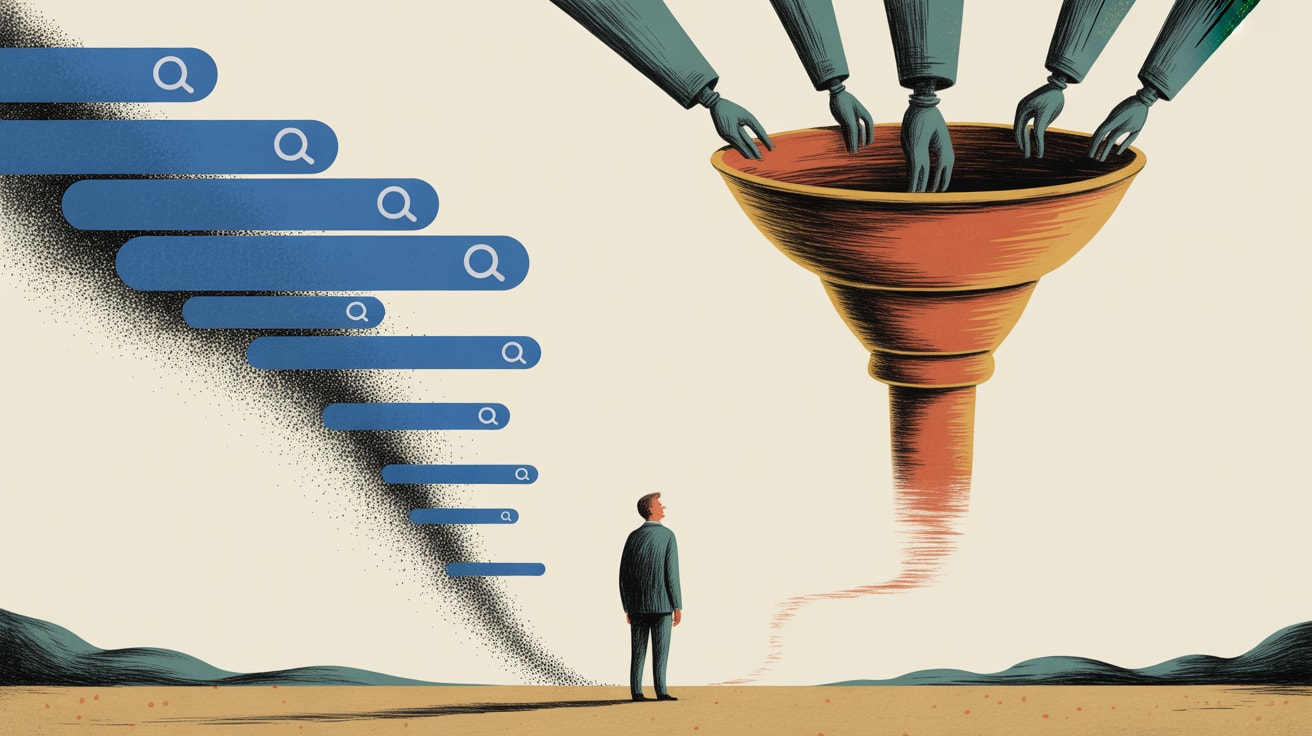
The marketing funnel didn’t just get disrupted. According to SEO.com’s Dan Shaffer, it got replaced — and most brands are still optimising for a journey their customers stopped taking.
Google’s latest Search expansion, reported by Semrush, introduces information agents that autonomously research on a user’s behalf, plus a Universal Cart that lets people purchase across multiple retailers in a single session. That’s not a UX refinement. That’s a structural change to how intent forms, how decisions get made, and where brands either show up or don’t.
The Funnel Is Now a Network of Agent Handoffs
The traditional funnel — awareness to consideration to conversion — assumed a human making sequential decisions. Agentic search breaks that assumption. Google’s information agents don’t browse; they query, synthesise, and act. A user asking “find me the best running shoes under $120 available for delivery in Bangkok by Friday” isn’t entering a funnel — they’re issuing a task brief to a machine that will resolve it without revisiting your product page three times.
SEO.com frames this bluntly: brands that haven’t restructured their content architecture to serve agent retrieval are effectively invisible to a growing share of high-intent queries. The Universal Cart compounds this — once a competitor’s product is in the cart, re-entry becomes structurally harder, not just competitively harder.
For Southeast Asian brands on Lazada and Shopee, this pattern is familiar. Platform-native search has always truncated the brand discovery journey. Agentic Google search is bringing that same truncation to the open web.
What Google’s Markdown Move Actually Signals
John Mueller’s explanation of why Google uses markdown for its developer documentation — covered by Search Engine Journal — is easy to file under “interesting but not urgent.” That would be a mistake.
Mueller’s core point: markdown creates cleaner, more parseable content structures that agentic systems can read and act on efficiently. Google uses it on its own dev docs precisely because it reduces ambiguity for automated consumption. Mueller was careful to note that most sites shouldn’t abandon current SEO fundamentals in a sprint toward agentic optimisation. But the directional signal is clear — content legibility for machines is becoming as strategically important as content relevance for humans.
Practically, this means auditing whether your high-value pages — particularly product specs, FAQs, pricing tables, and comparison content — are structured so an agent can extract a confident, actionable answer. Clean heading hierarchies, concise definitions, and schema markup are no longer just ranking signals. They’re the difference between being cited by an agent and being skipped.
Automate the Routine, Protect the Strategic
Ahrefs’ Ryan Law makes a useful distinction in his breakdown of content automation with Agent A: the tasks worth automating aren’t the creative ones, they’re the formulaic and analytical ones. Updating decayed content, pulling performance reports, identifying cannibalization issues, generating first-draft outlines for templated formats — these are all high-volume, low-creative-leverage activities that AI agents now handle reliably.
The strategic implication for SEO teams in Southeast Asia isn’t “will AI replace content roles” — it’s “how do we redeploy the hours automation frees up toward the work that actually differentiates.” Producing genuinely original research, building topical authority through expert-led analysis, and developing content specifically designed to be cited by answer engines — that’s where human editorial judgment still compounds.
Teams running lean, which describes most mid-market digital operations across the region, can realistically use agent-assisted automation to maintain publishing velocity while shifting senior resource toward answer engine optimisation (AEO) and GEO strategies that actually drive visibility in AI-mediated search.
Structuring Content for Agent Citation, Not Just Ranking
The practical pivot isn’t a full rebuild — it’s a layered audit. Start with your highest-traffic, highest-intent pages and ask a different question than you normally would: could an AI agent extract a complete, trustworthy answer from this page without clicking anything? If the answer is no, the page is vulnerable.
Specific steps that move the needle: implement FAQ schema on any page that answers a defined question; restructure long-form content so key conclusions appear in the first 100 words of each section rather than at the end; ensure product and service pages contain quantified claims (price ranges, delivery timelines, feature comparisons) rather than qualitative descriptions alone. For multilingual markets — critical across Thailand, Vietnam, Indonesia, and the Philippines — ensure these structured elements are consistent across language versions, not just translated.
Universal Cart eligibility on Google Search is still rolling out, but brands selling physical products should treat Merchant Center feed quality as an agentic readiness issue, not just a Shopping ads issue. Clean, complete, frequently updated product data is what agent retrieval systems draw from when resolving purchase-oriented queries.
Key Takeaways
- Restructure high-intent pages so AI agents can extract a complete, actionable answer without deeper navigation — heading hierarchy, schema, and quantified claims are the mechanics.
- Treat content automation as a capacity reallocation tool: free up senior editorial time for AEO and GEO strategies that build agent-cited authority.
- For Southeast Asian brands, Merchant Center feed quality and platform-native structured data are now agentic readiness signals, not just performance advertising inputs.
The uncomfortable question sitting under all of this: if agentic systems increasingly resolve purchase decisions before a user ever visits your site, what does brand equity even mean in search? Is the goal still to rank — or is it to become the source agents trust enough to cite without asking twice?
At grzzly, we work with marketing teams across Southeast Asia who are navigating exactly this transition — figuring out where traditional SEO still compounds, where AEO investment makes sense now, and how to build content architectures that serve both humans and the agents increasingly acting on their behalf. If you’re recalibrating your search strategy for 2026 and want a second opinion from people who’ve been in the weeds on this, Let’s talk.
Sources

Written by
Cosmic GrizzlyMapping the evolving cosmos of search — from traditional SERP dominance to answer engine optimisation and AI-cited authority. Obsessed with how machines decide what the world deserves to read.