
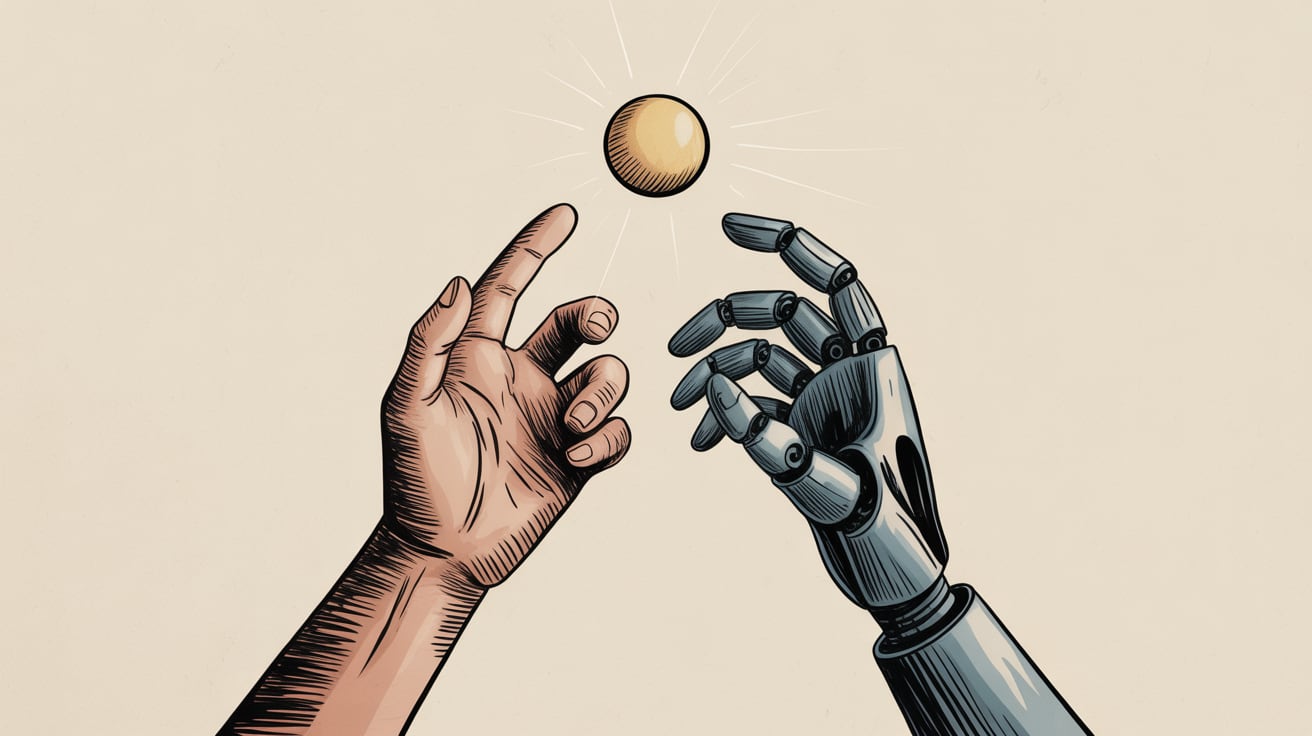
As AI floods every feed, the brands winning in Southeast Asia are doubling down on human truth. Here's what the evidence says — and what to do about it.
Feeds are full. Inboxes are full. And increasingly, both are full of content that was written by a model, commented on by a bot, and shared by an algorithm optimising for engagement signals that no human set. The question worth asking right now isn’t whether AI has a role in your content operation — it does — but whether the humans in your audience can still feel the difference. The evidence suggests they can. And they’re acting on it.
The Taboo Playbook: When Human Truth Is the Strategy
Andrex’s recent “Push Like You’re Pooing” campaign — developed with AMV BBDO and director King She at Somesuch — is one of the more instructive case studies in recent memory, not because of the subject matter, but because of the decision-making behind it. The campaign tackled the fact that midwives routinely use the sensation of a bowel movement to coach women through labour — a widely experienced but rarely discussed reality. Kimberly-Clark’s Matt Stone and ECD Kyle Harman-Turner described the process as one of surfacing an insight that was already true and simply refusing to sanitise it.
The strategic lesson isn’t “be provocative.” It’s that genuine human experience — especially the kind people recognise but don’t see reflected in brand communication — creates an immediate credibility signal. In Southeast Asian markets, where consumer trust in advertising benchmarks lower than in Western markets, this matters more, not less. Brands like Mama Suka in Indonesia and Pocari Sweat across the region have built durable loyalty precisely by reflecting real cultural rituals rather than aspirational fictions. The courage to name the real thing is itself a differentiator.
Social Proof Works — But Only When It’s Legible as Human
A HubSpot analysis by Phill Agnew makes a point that sounds obvious until you consider how few brands actually execute on it: the most persuasive social proof isn’t the most polished. Agnew documents how handwritten, visually inconsistent neighbourhood signs — the kind that look like a real person made them — consistently outperform professionally designed equivalents in driving local action. The mechanism is specificity and apparent effort: a sign that looks hand-made signals that a real person cared enough to make it.
This maps cleanly onto digital. On Shopee and Lazada, conversion rates on product listings with photo reviews from real customers — messy lighting, uneven framing, genuine product-in-context — consistently outperform listings with studio-quality imagery alone. The psychological dynamic is identical: perceived authenticity reduces purchase anxiety. For marketing teams tempted to moderate or replace organic UGC with cleaner brand assets, this is a cost worth interrogating carefully. The imperfection is often doing structural work that the polished version cannot.
The AI Content Problem Is Already Here, and It’s Upstream
Sprout Social’s Aubree Schaefer frames the emerging content ecosystem challenge with a question that should be pinned to every content team’s wall: if an AI post receives AI-generated comments, does any human care? The honest answer, backed by engagement data Sprout has been tracking, is increasingly no. The signal degrades. Reach may hold, but the downstream metrics — saves, shares, direct messages, purchase intent — fall away.
This isn’t an argument against AI in content production. It’s an argument for what Sprout calls a “human-generated content ecosystem” — a deliberate architecture where real employee voices, real customer stories, and real community moments anchor the content mix, with AI playing a support role in distribution, scheduling, and synthesis rather than origination. For Southeast Asian brands managing multilingual audiences across Thai, Bahasa, Filipino, and Vietnamese, the operational case for AI assistance is strong. The strategic case for keeping human voices at the centre is stronger. Audiences in high-context cultures are particularly attuned to whether the person behind the content actually knows them.
Owned Communities: The Infrastructure Play Most Brands Are Missing
The football fan engagement analysis from Martech Zone, focused on why clubs need owned digital communities, surfaces a structural insight that applies well beyond sport. The argument is straightforward: a 90-minute match is the content event, but the fan relationship runs continuously — pre-match context, in-game commentary, post-match analysis, transfer speculation, injury updates. Clubs that rely entirely on third-party platforms to host those conversations are building on rented land, subject to algorithm changes, reach suppression, and data opacity.
The parallel for consumer brands in Southeast Asia is direct. A beauty brand running campaigns on TikTok and Instagram is renting attention. A beauty brand that has built a LINE OA community of 200,000 engaged customers — where product questions get answered, where early access creates status, where real users post real results — owns a durable asset. Pomelo Fashion’s LINE community in Thailand and Sephora’s loyalty ecosystem in Singapore both demonstrate that owned community infrastructure compounds in ways that paid media cannot. The initial investment is higher; the long-term cost-per-engagement is significantly lower, and the data you collect is actually yours.
The thread connecting all of this is simpler than any of the individual tactics: trust is becoming a scarce resource, and it accrues to the brands that behave like they have something genuine to say to real people. The tools for faking that have never been more accessible. Which means the brands willing to do the harder work of being actually human — surfacing real insights, building real communities, showing real customer voices — are, quietly, pulling further ahead.
The open question is whether most marketing teams have the organisational permission to prioritise long-term trust-building over short-term output metrics. That’s not a technology problem. It’s a leadership one.
At grzzly, we help brands across Southeast Asia build content strategies that earn attention rather than buy it — from community architecture to content ecosystem design to the kind of campaign thinking that starts with a true human insight. If your current approach feels more like volume than signal, Let’s talk.
Sources
- https://www.campaignlive.co.uk/article/chants-midwives-birthing-bars-behind-scenes-andrexs-push-youre-pooing-campaign/1959404
- https://blog.hubspot.com/marketing/social-proof-master-class
- https://sproutsocial.com/insights/human-generated-content/
- https://feed.martech.zone/link/8998/17349307/football-fan-engagement-why-clubs-need-owned-digital-communities

Written by
Plot GrizzlyDocumenting the campaigns, systems, and decisions that actually moved the needle — with the intellectual honesty to include what failed and why. Narrative rigour as a professional standard.