Pinterest's half-billion high-intent users and AI agent platforms are reshaping digital strategy in 2026. Here's what Southeast Asian marketers need to act on now.
Two things happened this week that, taken separately, look like routine industry news. Taken together, they sketch the outline of a digital strategy reset that most Southeast Asian marketing teams haven’t fully priced in yet.
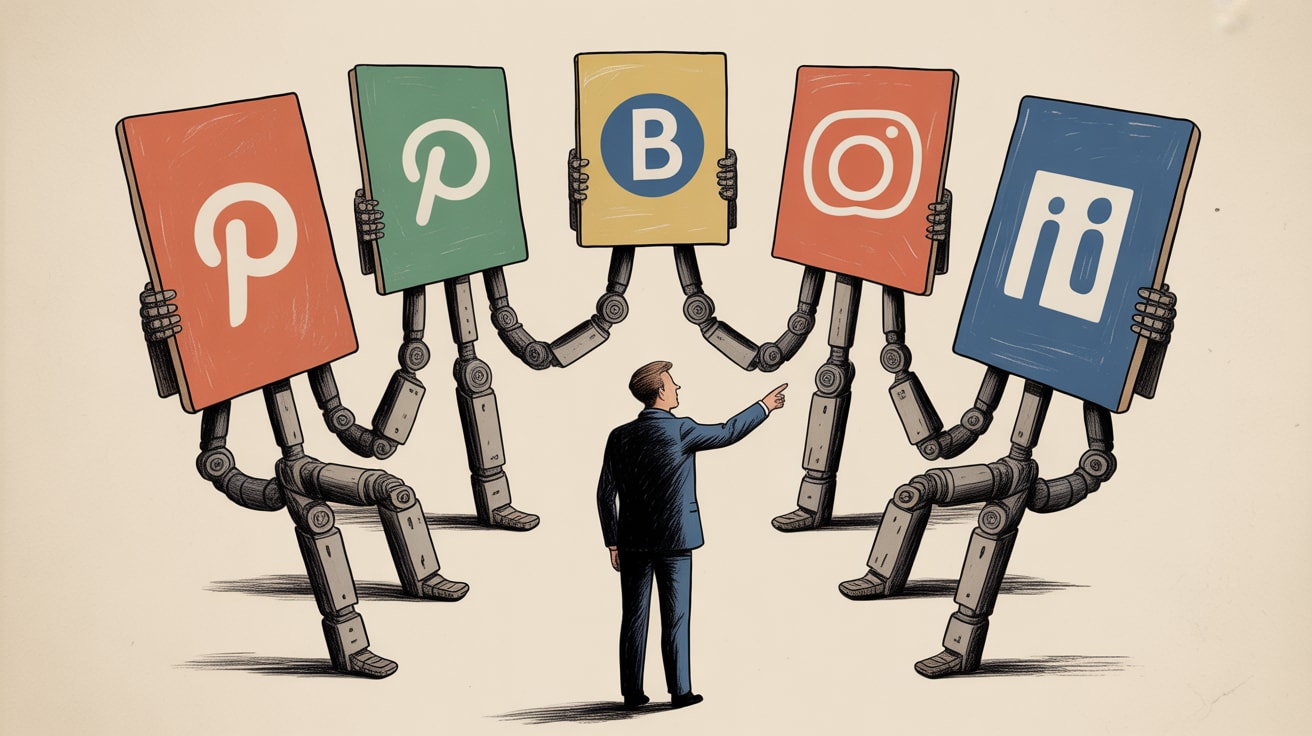
First: Pinterest crossed half a billion monthly active users, and Sprout Social’s 2026 data confirms what the platform has been quietly proving for years — it isn’t a social network, it’s a purchase-intent engine with a visual interface. Second: HubSpot publicly declared itself an “agentic customer platform,” signalling that the AI-as-assistant era is over and the AI-as-operator era has begun. These two developments aren’t competing headlines. They’re the same story told from different angles.
Pinterest Is Not a Social Platform — And That Distinction Is Doing Real Work
Most digital strategy decks in the region still treat Pinterest as an afterthought, wedged between TikTok and LinkedIn in the channel mix. That’s a strategic miscalculation. According to Sprout Social’s 2026 statistics roundup, over 80% of weekly Pinterest users have discovered a new brand or product on the platform — and critically, users arrive with intention. They’re not passively scrolling; they’re actively searching for solutions, styles, and purchases.
For Southeast Asian markets, the implications are specific. Pinterest’s mobile-first architecture aligns well with the region’s browsing behaviour, and categories like home décor, fashion, and food — all high-growth retail verticals in markets like Thailand, the Philippines, and Vietnam — consistently over-index on the platform. A mid-sized Indonesian furniture brand that optimised its Pinterest presence around search-intent keywords in Bahasa Indonesia reported meaningful organic traffic growth without paid amplification. The channel rewards strategic SEO thinking, not just content volume.
The practical implication: treat Pinterest like a search engine with a visual index, not a feed to populate. That means keyword-led board architecture, product-linked pins with clean metadata, and category pages built to match discovery queries — not brand storytelling.
The AI Agent Inflection Point Is Already Past Theoretical
HubSpot’s Duncan Lennox framed it plainly in a recent post: the platform has shifted from helping teams do work to doing the work for them — qualifying leads, resolving service tickets, and managing deal pipelines through autonomous agents. This isn’t a roadmap slide. HubSpot is calling it live, and the open ecosystem framing means the agent layer is designed to connect with external tools, not just its own stack.
For digital strategy teams, this is the moment where the org chart starts to feel pressure. If AI agents can handle lead qualification and first-response service at scale, the question isn’t whether to adopt — it’s which workflows to hand over first, and which human judgment calls remain genuinely irreplaceable. The brands that get this wrong will over-automate the nuanced and under-automate the repetitive.
Michael Stelzner’s breakdown of Claude Code on Social Media Examiner adds another layer: custom AI tooling is no longer a developer-only capability. A digital strategist who can build a basic Claude Code automation — say, a workflow that pulls Pinterest keyword data, cross-references it with a product catalogue, and auto-drafts pin descriptions — is operating at a different level of leverage than one who can’t. The barrier to building proprietary AI tools has dropped to near zero.
What M&S’s Campaign Rotation Actually Teaches About Talent Strategy
On the surface, M&S swapping Gillian Anderson for Amelia Dimoldenberg in its “Love that” campaign is a celebrity-talent story. But read it as a case study in campaign architecture and there’s more to extract. M&S isn’t retiring the campaign — it’s rotating the spokesperson while keeping the platform intact. The creative system outlasts any individual execution.
This is the discipline that most Southeast Asian brands still struggle with: building campaigns that have structural longevity, not just a great launch month. Grab has done this well — its core brand platform has absorbed multiple product launches, market expansions, and cultural moments without needing to rebuild from scratch each time. The spokesperson changes; the strategic frame holds.
For teams planning H2 2026 campaigns, the practical question is whether your campaign architecture can absorb a talent swap, a platform shift, or a market shock without losing coherence. If the whole thing depends on a single creator’s face or a single channel’s algorithm, it’s a tactic dressed as a strategy.
Connecting the Signals Into a Coherent 2026 Posture
Here’s the synthesis: digital strategy in 2026 isn’t about picking the right channels anymore. It’s about building the connective tissue between high-intent discovery surfaces (Pinterest), autonomous execution layers (AI agents), and durable creative platforms (campaign architectures that can outlast any single execution).
The brands that will compound growth this year are the ones treating these three elements as a system, not a checklist. In Southeast Asia specifically, that means mobile-first discovery design on Pinterest optimised for local language search, AI agent workflows that handle the repetitive end of the funnel, and brand platforms built for resilience rather than novelty.
The old question was: which channels should we be on? The better question now is: what can we build that makes each channel work harder than it would in isolation?
Key Takeaways
- Pinterest’s half-billion high-intent users warrant a search-engine strategy, not a content calendar — especially in Southeast Asia’s high-growth retail categories.
- AI agent platforms have crossed from experimental to operational; the strategic question is workflow prioritisation, not adoption timing.
- Campaign longevity comes from structural architecture, not individual executions — build platforms that can absorb change without losing strategic coherence.
The shift from channel management to system design is already underway for the brands paying attention. The real question isn’t whether AI agents and high-intent platforms will reshape your digital strategy — they already are. It’s whether your team is structured to build across these layers, or still optimising each channel in its own silo.
At grzzly, we work with digital and growth teams across Southeast Asia to turn exactly this kind of signal-reading into coherent, executable strategy — from channel architecture and AI workflow design to campaign platforms built for the long game. If any of this is landing close to a conversation you’re already having internally, let’s talk.
Sources
- https://sproutsocial.com/insights/pinterest-statistics/
- https://blog.hubspot.com/marketing/our-vision-for-building-an-open-ecosystem-for-the-agent-era
- https://www.socialmediaexaminer.com/claude-code-for-everyone-how-to-get-started/
- https://www.campaignlive.co.uk/article/m-s-adds-amelia-dimoldenberg-%E2%80%9Clove-that%E2%80%9D-campaign/1956999

Written by
Vintage GrizzlySynthesising channel intelligence, audience psychology, and market context into coherent growth strategies. Old enough to remember the last paradigm shift; sharp enough to see the next one forming.