Condé Nast is planning for zero search traffic. Here's what AI search engines actually reward — and how SEO strategy must shift in 2026.
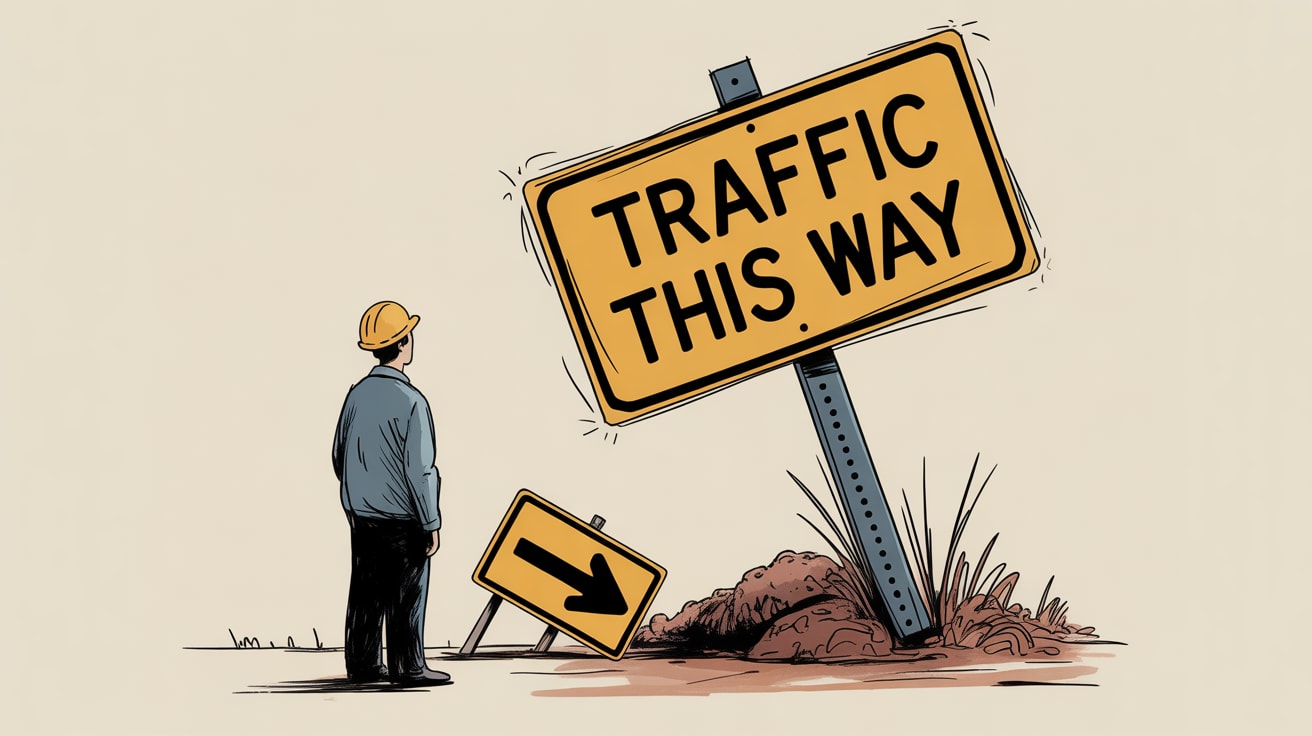
Condé Nast CEO Roger Lynch has told his teams to plan as if search traffic will reach zero. Not as a thought experiment — as a working forecast. Three consecutive years of underestimating actual traffic declines will do that to your planning assumptions.
If one of the world’s most resourced content operations is building contingency plans around zero organic search, the question for the rest of us isn’t whether AI search disruption is real. It’s whether the optimisation work we’re doing right now is actually building the right kind of discoverability.
The Metric You’re Watching Is the Wrong One
Search Engine Journal’s coverage of Lynch’s remarks is striking not for the drama of the statement, but for what it implies about forecasting failure. Three years of underestimated decline means three years of strategy built on a model that was already breaking. The teams weren’t wrong about the direction — they were wrong about the speed.
For marketing directors still reporting on organic sessions as a primary KPI, this is the uncomfortable reframe: traffic volume was always a proxy metric for something else — brand reach, audience trust, commercial intent. AI-generated answers don’t always produce a click, but they do produce an impression. The brands that appear inside those answers are building something. The brands that don’t are becoming invisible in a way that won’t show up in your analytics until it’s too late to recover quickly.
In Southeast Asia, this shift lands differently. Platforms like Grab, Shopee, and LINE increasingly function as closed discovery environments — AI-assisted search within their own ecosystems. Organic Google traffic was never the only game here, but the underlying logic is identical: if your brand isn’t surfaced by the system making the recommendation, you’re not in the consideration set.
Schema Is Necessary But Not Sufficient — The Ahrefs Data Explains Why
Ahrefs recently tracked 1,885 pages to understand the relationship between structured markup and AI citations. The finding that circulates on LinkedIn is that AI-cited pages were almost three times more likely to have JSON-LD than non-cited pages. That sounds like a clear mandate for schema implementation.
But the more important finding is the one people skip: adding schema to pages that previously lacked it barely moved citation rates. The correlation between schema presence and AI citation exists — the causal arrow from schema implementation to citation does not run as cleanly as the headline implies.
What this suggests is that schema is a qualifying condition, not a ranking factor. It signals to AI systems that a page is structurally legible — that entities, relationships, and claims are explicitly declared rather than inferred. Pages that already had strong entity authority and topical depth happened to also have JSON-LD. Adding markup to thin or weakly-authoritative content doesn’t manufacture that underlying signal.
The practical implication for teams: audit your schema as a hygiene measure, but don’t treat it as a shortcut. Article, FAQPage, HowTo, and Organization markup with accurate, complete attributes should be standard across any content that targets informational queries. In multilingual Southeast Asian contexts, inLanguage and areaServed schema properties are frequently missing — a straightforward gap to close.
Content Length for AI Search: The Answer Is More Annoying Than You’d Like
SEO.com’s analysis of content length for AI search engines reaches a conclusion that sounds unhelpful until you understand the mechanism: optimal length depends on query complexity, not on a target word count. A transactional query about a product specification doesn’t need 2,000 words. A strategic question about category selection might need exactly that to demonstrate the topical coverage that generative engines use to assess source authority.
The more actionable frame is content completeness over content length. AI systems pulling citations are pattern-matching against the full scope of a topic — they’re checking whether a source addresses the question, the adjacent questions, and the contextual nuance a real user might follow up with. A 600-word page that answers a narrow query precisely can outperform a bloated 2,500-word page that buries the answer in qualifications.
For teams producing content at scale across Southeast Asian markets, this creates a genuine workflow challenge. Localising content for Thai, Bahasa Indonesia, Vietnamese, and Filipino audiences isn’t just a translation task — it’s a topical completeness task in each language. A page that reads as authoritative in English may be superficial in Bahasa because the local context — regulatory nuance, platform-specific behaviour, regional price sensitivity — is absent. AI engines operating in those language contexts will reflect that gap.
Building for Discoverability When the Click Disappears
The Condé Nast signal shouldn’t produce panic — it should produce clarity about what durable brand authority actually looks like in an AI-mediated search environment. The brands that will weather zero-click futures are the ones being cited, referenced, and recommended by AI systems because their content is structurally coherent, topically authoritative, and entity-rich enough to be unambiguously identified.
This is the quiet work of generative engine optimisation: building a semantic footprint that AI systems can recognise and trust. Named entity consistency across your owned properties and third-party mentions. Structured data that declares rather than implies. Content that answers questions completely rather than keyword-stuffing for a crawl. In a region where brand recognition is often built through platform ecosystems rather than search, the brands investing in this infrastructure now are accumulating an advantage that won’t be visible in dashboards until their competitors start asking why they keep appearing in AI-generated recommendations.
The question worth sitting with: if your brand’s search traffic dropped to zero tomorrow, what else would still be driving discovery — and is that channel strong enough to carry the load?
At grzzly, we work with growth teams across Southeast Asia on exactly this transition — from traffic-dependent SEO into structured entity authority and AI-ready content architecture. If your forecasts are starting to look like Condé Nast’s, it’s worth having a direct conversation about what the next optimisation layer actually looks like for your brand. Let’s talk
Sources

Written by
Sneaky GrizzlyTracking the quiet revolution inside LLM-powered search — where brand mentions, structured semantics, and entity authority rewrite the rules of discoverability before most marketers notice.