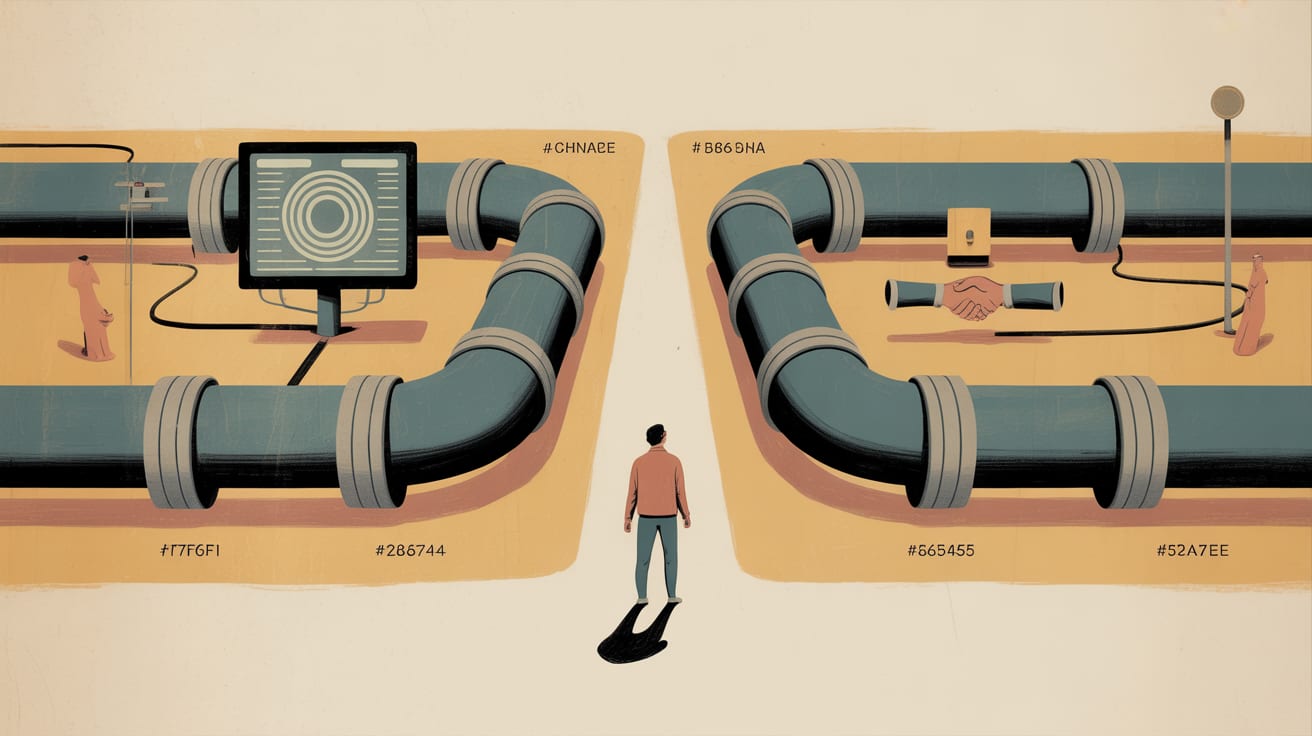
AI UX debt is accumulating faster than teams can ship. Here's what Southeast Asian design and data teams must do before the bill comes due.
Brands across Southeast Asia are shipping AI features at a pace their design infrastructure was never built to support. The UX debt is accumulating quietly — and unlike technical debt in a data pipeline, you often don’t feel it until a competitor’s product suddenly feels effortless and yours feels like filling out a government form.
The Kindness Problem Nobody Budgeted For
UX Collective’s Fabricio Teixeira recently surfaced something that sounds soft but has hard commercial consequences: the tone of human-AI interaction has fundamentally shifted. We’ve moved from barking commands at voice recognition to negotiating, apologising, and occasionally venting at systems that have no stake in the outcome. What this signals, from a design architecture standpoint, is that the conversational layer of AI products is now load-bearing — and most teams aren’t treating it that way.
Claude’s branding is the clearest proof of this. Anthropic made a deliberate choice to position their model as warm and considered, not omniscient. The visual identity is soft, the naming is human, and the interaction patterns are calibrated to reduce user anxiety rather than perform capability. That’s not a marketing decision — it’s a UX systems decision that cascades into retention, trust, and the willingness of users to attempt harder tasks. For brands building on top of AI APIs in markets like Thailand or the Philippines, where interpersonal communication norms are high-context and relationship-driven, this tone architecture isn’t optional. It’s the product.
Fast vs. Better: The Metric That Separates Good AI UX from Expensive Mistakes
Daisy Chen’s observation, surfaced in the same UX Collective roundup, is the one I’d put on the wall of every product sprint: the best AI tools make users better, most only make them faster. This distinction matters enormously when you’re designing data-facing interfaces — the kind that sit on top of a lakehouse or BI layer and get handed to marketing teams who’ve never written a SQL query.
A dashboard that auto-generates insights from your Shopee or Lazada sales data is fast. A dashboard that teaches your merchandising team to ask sharper questions over time — that’s better. The first creates dependency. The second creates organisational capability. The UX patterns that enable the second are harder: progressive disclosure of complexity, contextual explanation of why a metric moved, inline annotation that survives the original analyst’s departure. None of these are default states in off-the-shelf tooling. They require intentional design investment, and they require the data team and the UX team to be in the same room, which is still a rarer condition than it should be.
When the Interface Becomes the Liability
Theresa-Marie Rhyne’s account of using Grok to navigate Adobe Color’s updated interface reads, on the surface, as a productivity story. A researcher uses an AI assistant to shortcut a confusing UI refresh. It works, mostly. But read it as a data architect and the signal is different: when users are routing around your interface via a third-party AI because the interface itself has become too complex to navigate directly, you have a systemic design problem that no amount of onboarding copy will fix.
This pattern is emerging across enterprise SaaS products in the region. Grab’s merchant portal, various telco self-serve dashboards, regional ERP interfaces — all are accumulating complexity faster than design teams can rationalise it. And as GenAI assistants become the de facto navigation layer on top of these tools, the underlying UX debt doesn’t disappear — it gets abstracted. Abstracted debt is still debt. It just charges interest in user confidence and data quality, not in support tickets.
The implementation risk is concrete: if your users are relying on a third-party AI to interpret your own product’s interface, that AI is now a dependency in your user journey — one you don’t control, can’t instrument, and can’t optimise. For teams running analytics infrastructure, this is exactly analogous to undocumented data transformations sitting in a notebook someone ran once in 2023. It works until it doesn’t, and when it doesn’t, nobody knows why.
Designing the Foundation, Not Just the Surface
The throughline across all three signals is this: AI UX isn’t a feature you add to a product, it’s a structural property of how information moves from system to human. The brands in Southeast Asia that will build durable AI product advantages are the ones treating their interaction layer with the same rigour they apply to their data layer — with documented design systems, clear deprecation policies for UI patterns, and explicit decisions about what the product should teach users versus what it should simply do for them.
Concretely, that means three things product and data teams can act on now. First, audit which AI-facing interfaces your users are navigating via workarounds — third-party AI assistants, browser extensions, manual exports — because each workaround is a symptom of UX debt. Second, instrument the quality of AI interactions, not just volume: are users asking more sophisticated questions over time, or the same basic ones? The trend line tells you whether your design is building capability or dependency. Third, bring tone architecture into your design system documentation as a first-class component — especially if you’re building for multilingual Southeast Asian audiences where a single curt microcopy choice can read very differently in Bahasa than in English.
The question worth sitting with: if your AI product disappeared tomorrow and your users had to work without it, would they be more capable than before they started using it — or less?
At grzzly, we work with marketing and data teams across Southeast Asia to design intelligence infrastructure that actually changes how organisations think — not just how fast they can pull a number. If you’re building AI-facing products and want a perspective on where your UX and data architecture might be quietly accumulating debt, Let’s talk.
Sources

Written by
Chunky GrizzlyDesigning the foundational plumbing — data warehouses, lakehouse models, and ETL pipelines — that separates organisations with genuine intelligence from those drowning in dashboards.